Start CS2 with one map, one rifle to practise and one clear task for each session. You do not need a professional config or a library of grenade lineups before your first match. You need to understand what the round asks of you and recognise why your last attempt failed.
This guide takes you from your first launch to useful decisions in a team. The exercises are suggestions, not entry requirements or a promise of a particular rank. For the wider collection, visit the CS2 guide hub.
Before the first match
Install Counter-Strike 2 through Steam. Start the game once before importing anybody else's settings. Check that you can read the interface, hear the game comfortably and use the controls without looking down at the keyboard.
Keep your initial setup simple. Choose a crosshair you can see against both bright and dark backgrounds. Try turning towards two different points on a wall: if you repeatedly overshoot, adjust your mouse sensitivity a little, then repeat. Do not change sensitivity after every lost fight; you need a consistent reference to learn from.
Our CS2 settings guide covers the graphics decisions in more detail. If the game stutters even when you are only moving around, use the FPS troubleshooting guide before treating every missed shot as an aiming problem.
Do you need Prime immediately?
No: you can try CS2 for free. Valve's Prime FAQ states that Premier requires Prime Status and Profile Level 10. Prime also enables XP, Competitive Skill Groups and CS Rating. Buy it when you want those features; it is not a shortcut through learning the game.
Understand the round before chasing a kill
On bomb-defusal maps, Terrorists attack bombsites and Counter-Terrorists defend them. Planting and defending the bomb, or preventing the plant and defusing it, changes what a sensible fight looks like. These instructions concern that format; do not assume every community mode has the same objectives.
Before moving, ask three questions: where is the bomb, where are my teammates, and what would happen if I died here? For example, carrying the bomb alone into an uncleared area can force the rest of your team to recover it. Staying close enough to an attack to deliver the bomb is often more useful than searching for an isolated duel.
After a plant, choose a position from which you and a teammate can protect the bomb. Agree who watches each approach. Running away to search for another opponent can open the route you were supposed to cover. A good round can finish without you taking another fight.
A short shooting session with a clear goal
The basic habits are simple: stop before firing a rifle, learn its recoil, use cover and share useful information. Coordinate purchases and give each grenade a purpose. These fundamentals also appear in ProSettings' beginner guide, the starting point for this article.
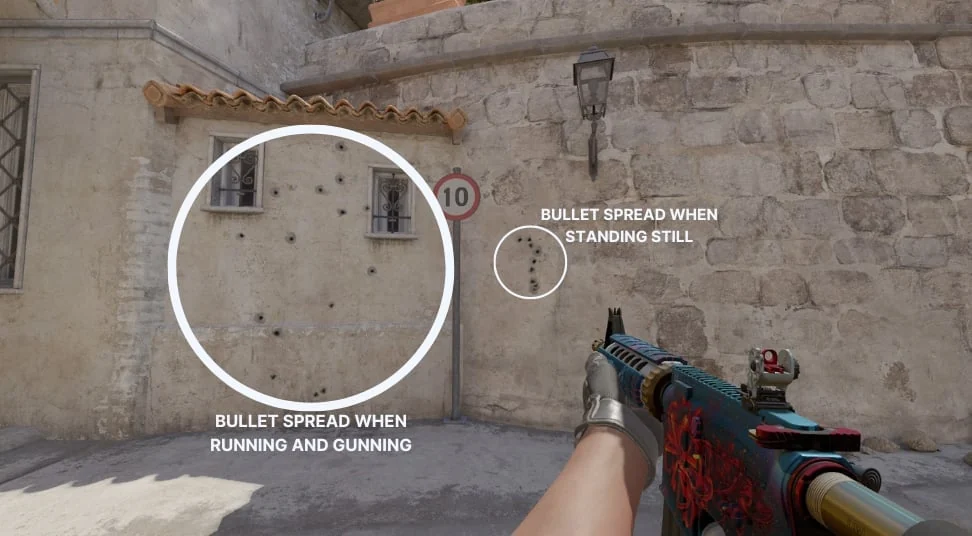
For your own practice, pick the AK-47 or an M4 and keep the same weapon for the session. Try this comparison on a practice map:
- Choose a visible mark on a wall and take several separate shots while stationary.
- Move sideways, stop, then try the same shot. Pay attention to whether you fired before finishing the stop.
- Fire a short burst. Compare the group with the single shots, then repeat from the same place.
- Finish with a few attempts at a longer burst. Stop the exercise when you can explain the difference you are seeing.
Do not judge the drill by how quickly you empty a magazine. Record one observation, such as “my first shot is fine, but I keep firing after losing the target.” That gives your next session a specific problem to solve.
For dedicated recoil work, the creators of Recoil Master for CS2 provide a Workshop map with a visual recoil-compensation guide. It is an optional community tool. Use the CS2 version and check its current description if something behaves differently after a game update.
Learn one route well enough to explain it
Pick a map your friends play or one you want to learn. Walk from spawn to each bombsite, then between the sites. At every junction, look back: recognising a location from the opposite direction matters when you rotate or retreat.
For your next match, choose one route to focus on. Note the first exposed crossing, a place to pause and the next corner you need to check. Avoid turning this into a memorised sprint. Your route should change when a teammate reports contact or the bomb moves elsewhere.
Learn names as you need them. A clear “two at B entrance, moving onto site” is more helpful than a confident but incorrect callout. Describe what you actually saw; separate that from a guess. “I saw one” does not mean only one opponent is there.
Make a plan while buying
Before spending, ask the team whether this is a buy round or a saving round. Then choose equipment for the intended play. The table below is a decision aid, not a fixed purchase order: your money, weapons carried over and teammates' equipment all matter.
| Situation | Useful question | Practical response |
|---|---|---|
| The team wants to save | What should we keep for next round? | Agree a spending limit before purchasing. |
| You can afford more than a teammate | Would a weapon drop improve our buy? | Ask what they need instead of buying an extra weapon blindly. |
| You are joining an attack | Who enters, and who supports? | Choose your position and grenade job before the push starts. |
| You are defending a site | Who covers the other approach? | Confirm the division of responsibility before contact. |
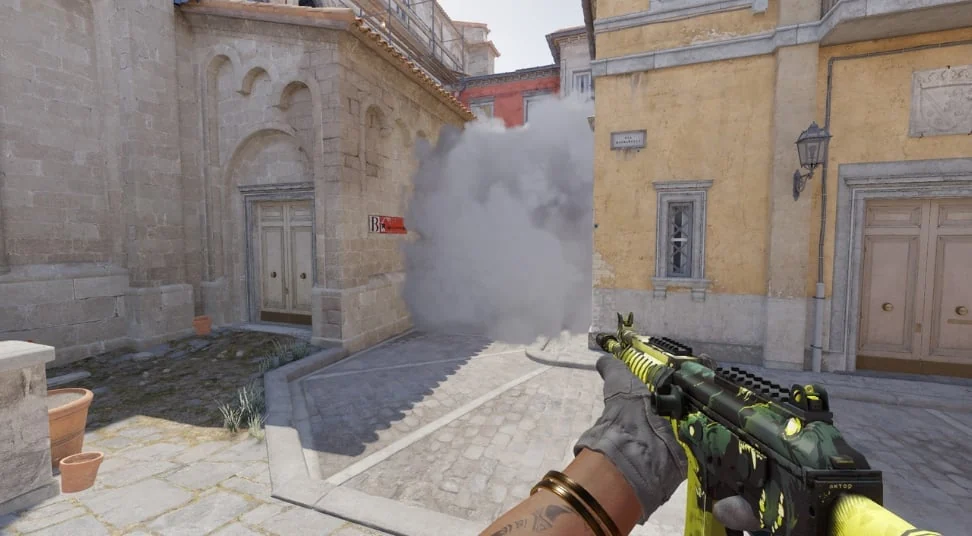
For a first grenade task, choose one specific sightline you want to block with smoke. Practise the throw, then stand at the other end and inspect the result. Can your teammate cross? Is there a gap? This teaches you to assess the purpose of a throw instead of merely reproducing mouse movements from a video.
Keep communication short during the action. Compare “why didn't you help?” with “wait for me; I'll go with you.” The second gives the next attempt a plan. If someone becomes abusive, use the game's mute controls and keep communicating useful information to the others.
A plan for your next three sessions
Each session can be short. Move on when the exercise is still productive; an exhausted hour is not automatically better than ten focused minutes.
- Session one: control. Check settings, choose your rifle and repeat the stationary-shot and stop-then-shoot comparison.
- Session two: orientation. Walk your chosen route, learn the locations where you got lost and practise one useful grenade.
- Session three: team play. Enter a match with one goal: explain your intended action before doing it. Afterwards, identify one round where that helped or would have helped.
After each match, write down one moment rather than “my aim was bad.” Examples: “I reloaded as my teammate entered,” “I forgot where we dropped the bomb,” or “I could not name the entrance I was watching.” Turn that moment into tomorrow's exercise. This is a practical review method, not a rank guarantee.
Questions before you queue again
How do I know I am ready for a team match?
You do not need perfect aim. A useful starting point is being able to find the bombsites, understand the current objective, follow a shared buy and explain where you saw an opponent. Tell your teammates that you are learning. Set aside time to finish the match.
Should I copy a professional player's settings?
You can try them as a reference. Keep a record of your previous settings and test whether the change solves a problem you actually have. A professional's mouse, desk space and habits may differ from yours.
What should I work on after a bad match?
Choose the mistake you can reproduce. If you cannot identify one, watch a few of your own rounds or ask a friend to explain a single decision. Changing the crosshair, sensitivity and graphics together makes it harder to tell what helped.